
Signaling Broker Platform
Centralized signaling control for modern telecom networks

Detect, control, and manage signalling traffic across networks
Enghouse Networks Signaling Broker Platform enables operators to manage and control signaling traffic across multi-technology networks. By applying policy-based routing and centralized traffic management, operators can optimize signaling flows, maintain interoperability, and support network evolution.
Key Benefits
The platform integrates with existing telecom infrastructures, allowing operators to introduce centralized signaling control without disrupting current operations. It supports both legacy and modern network environments, enabling gradual network evolution.





Capabilities / Key Features
The platform provides a centralized signaling control layer that manages routing decisions across network elements. Through configurable policies, operators can define how signaling traffic is handled, routed, and distributed.
It supports interworking between signaling protocols and enables consistent traffic management across legacy and next-generation networks.

Scenario: Telecom networks operate across multiple signalling protocols, network domains, and interconnections. As traffic volumes increase and networks evolve towards LTE and 5G, signalling environments become more complex to manage. Without centralised control, operators face challenges in maintaining service continuity, managing traffic efficiently, and protecting the network from overload and abnormal signalling patterns.
Solution with Signalling Broker Platform: By providing a centralised signalling control layer, Enghouse Signalling Broker Platform enables operators to manage signalling traffic across protocols and network domains using policy-based rules. Operators can control traffic flows, ensure interoperability, and apply safeguards to maintain network stability and prevent the impact of unwanted or abnormal signalling activity.
Results: Improved signalling visibility and control, enhanced network stability, reduced operational complexity, and increased protection against abnormal traffic conditions.
Why Choose SBP?




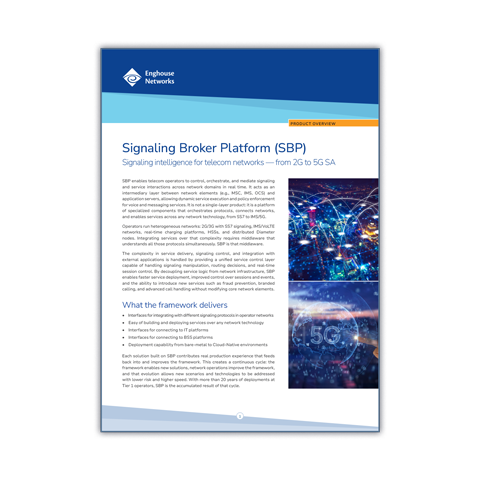
Enable resilient, high-performance signaling for evolving telecom networks.
As networks expand across multiple technologies and signaling protocols, operators face increasing complexity in managing traffic flows and maintaining service continuity. The transition toward LTE and 5G further intensifies the need for scalable and efficient signaling control.
Enghouse Networks helps operators simplify signaling environments by centralizing control and enabling consistent traffic management across network domains. By optimizing signaling distribution and supporting interoperability, operators can maintain network stability while preparing for future network evolution.
FAQs
SBP
SBP can be deployed either as a broader signaling framework or to solve a specific problem, such as CDR or CDF generation for Diameter-based charging scenarios, with limited impact on existing infrastructure.
Yes. SBP supports 5G SA charging and policy functions through CHF and PCF capabilities, connecting the 5G Core with operator billing and policy logic.
SBP connects to IT and BSS platforms through standard interfaces such as HTTP, SOAP/WS, JMS, SMTP, ZMQ/AMQ, and ODBC, and has proven interoperability with telecom platforms such as OCS, HSS, and AS environments.
SBP separates network integration from service logic, so once integration with existing network elements is in place, application teams can build and update services without working directly at the signaling layer.
SBP does not replace core routing nodes such as STPs or DRAs. It works as an additional layer that adds service execution, business logic, and charging capabilities on top of the existing signaling infrastructure.
With more than 20 years of deployments at Tier 1 operators, SBP is designed around real-world signaling challenges such as protocol gaps, proprietary interfaces, and non-standard integration requirements.
SBP is a signaling framework that acts as middleware between network elements and service applications. It orchestrates voice, data, and messaging protocols across heterogeneous telecom networks.
SBP provides real-time KPIs, alarms, and session-level visibility, with observability support through Prometheus, Grafana, Elastic Stack, and Jaeger for troubleshooting signaling flows.
SBP helps operators manage signaling complexity across legacy and modern environments, including SS7, Diameter, SIP/IMS, and 5G SA interfaces, without forcing service logic into core network nodes.
SBP provides the signaling foundation for platforms such as converged charging, intelligent routing, IVR and media services, roaming solutions, and other telecom applications that need deep network interaction.
SBP supports legacy and IP-based telecom signaling, including CAMEL, INAP, Diameter interfaces such as Ro, Ro+, Gy, Gx, and Sy, SIP ISC, SIP-T, SIP-I, MAP, SMPP, and 5G SA interfaces such as Nchf and Npcf.