
Beginning as a developer-first and API centric way to resell carrier services, the Communications Platform as a Service (CPaaS) is a relatively recent development. Within the CPaaS, unified communications and cloud communications industry itself, Bring Your Own Carrier (BYOC) is a new and hugely disruptive trend that is rapidly challenging the old ways of doing things.
These services have found a natural market with enterprise developers with a particular set of enterprise challenges to try and solve. Often beginning with enabling IVRs, DIDs and SMS notifications, the potential scope grew to include enterprise Contact Centers and Unified Communications. Both of these are massive markets that previously maintained their own vendor ecosystems.
Underlying carrier relationships have been reconfigured as a result of this trend. Telecoms becomes a feature of Software as a Service (SaaS) while systems migrate to the cloud, but the contracts and interconnections can sometimes present challenges.

Deal friction increases with scale, as porting numbers and the ending of long term carrier service agreements creates particular challenges. It can often be easier to allow enterprise customers to bring their continuing carrier relationships into the SaaS platform.
Why does BYOC make more sense?
There are a number of key reasons why BYOC can be a smarter option:
- Simplified regulatory environment
Voice services are subject to extensive and sometimes complicated regulations at the local, state and national level. When the international dimension is considered with all of the regulatory hurdles required to be taken into account, it soon becomes obvious that enabling customers to manage this locally and bilaterally offers a simpler, more straightforward approach.
- Interoperability
Certificate programs to validate a curated list of SIP trunking partners from which their enterprise customers could choose were often a part of the offer from early Unified Communications as a Service (UcaaS) providers. As parameters change rapidly all too easily creating a lag in compliance, this approach can quickly grow complicated. The enterprise again needs to focus on reengineering their interconnection partners. By instead focusing certification efforts on standards-based SBCs, interconnection becomes more flexible and open.
Real commercial value
It’s well established that cloud communications and their evolving business model add real value to enterprise, and the extent of that value continues to grow. Whereas early CPaaS solutions were generating their principal revenue stream from reselling carrier services, it’s now more software driven. As a result the picture is more complicated. The all-important reduction in deal friction that BYOC brings is key. Large enterprises are often locked into long term contracts, or do not want to risk porting mission critical numbers.

How can Enghouse Networks help?
The key to interoperability between IP networks is your Dialogic Session Border Controller (SBC). If you are a Cloud Communications company interested in enabling BYOC, or an enterprise seeking to connect to new SaaS providers, we can help with our internetworking software and expertise already running on all the major public clouds.
Your Dialogic SBC also takes care of transcoding. You don’t need to take care which codecs are being used by different operators. Your Dialogic SBCs enable rapid scaling. You can even start with a trial, and then scale up as required with Dialogic software in the AWS Marketplace.
Learn More
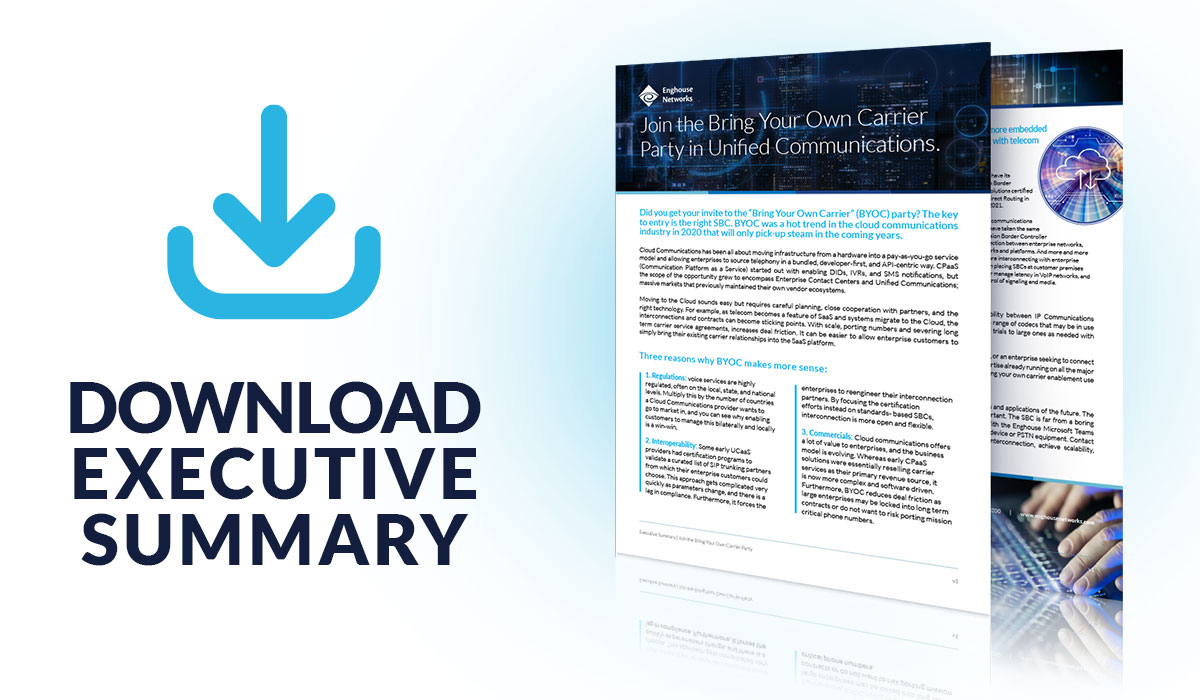
You can learn more about our thinking on the future of the Session Border Controller by downloading our new Enghouse Executive Summary “Join the Bring Your Own Carrier Party in Unified Communications”.
Let’s start a discussion on enabling new modes of interconnection, for CPaaS and UC!