

But are we missing the bigger picture?
According to a Cowen and Company survey, network experience is the top factor impacting telecom users’ critical buying decisions and reason for churn – even more than price and customer service. In other words, quality trumps everything else – which means it also needs to be first and foremost for network operators. For those who work in the telecom OSS domain, service quality has always been our focus, and many have been arguing the benefits of service assurance vs. network assurance for the past thirty years. This service operations center (SOC) vs. network operations center (NOC) battle for managing the network has become a philosophical debate. One side believes that by tightly managing the network (the NOC approach), services running over it will also be okay. On the other hand, some think it’s better to focus on assuring services, or the SOC approach. After all, that’s what subscribers are buying.
A new inventory-first approach is needed due to the increasing complexity of networks, services, partners, business models, devices, and other endpoints.
In both NOC and SOC scenarios, operators end up with silos of data that provide a limited view of the types of information needed daily. They struggle to answer critical questions, such as ‘how much extra network capacity will be required to support additional services?’ or ‘what’s the best way to make a change to the network so that it doesn’t impact downstream services?’ The NOC or SOC approach would have worked in years past when things were more straightforward, but today’s networks are disaggregated and complex and must operate at an unprecedented scale and speed. With so many moving parts, it’s necessary to take a step back to gather an accurate view of network assets and connectivity to fully understand the current lay of the land.
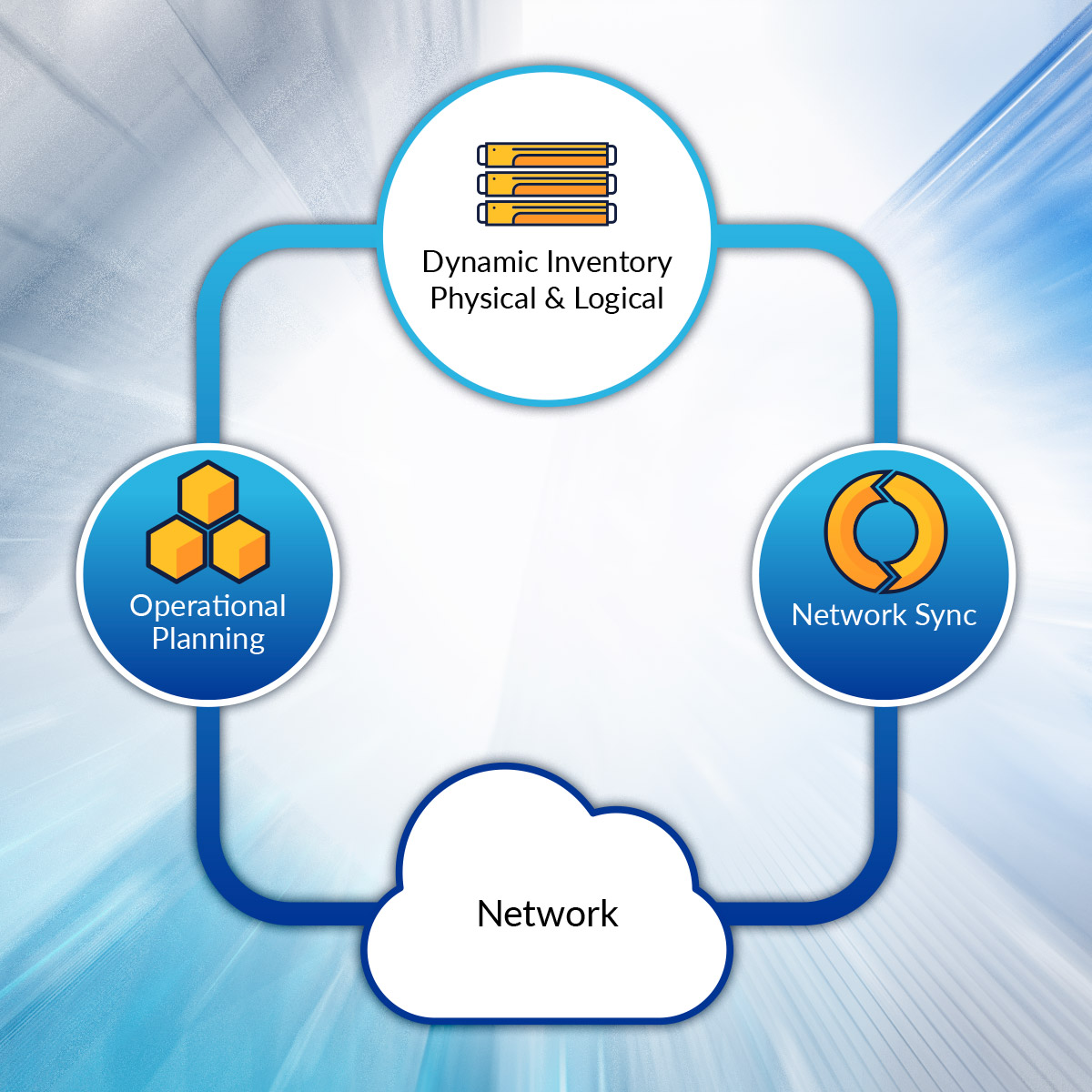
By taking a bottom-up approach that begins with a view into an active, dynamic inventory, service providers are better equipped to address four vital operational challenges:
- Network Complexity: The ability to discover and normalize inventory across multiple technologies, vendors, and approaches, provides more significant operational insights across the organization and allows everyone to work from the same source of ‘truth,’ but today’s disaggregated and hybrid networks, along with new devices and IoT endpoints, makes this more challenging than ever.
- Constant Change: With an accurate inventory, managing a highly variable, dynamic network becomes simpler. Teams can benefit from the just-in-time allocation of resources, improve network capacity utilization, and even optimize power requirements.
- Need for Accuracy: The ability to map network resources to the services running across them has become a core necessity that also benefits other critical business functions, including network planning, finance, and even marketing and sales. In addition, new network-as-a-platform business models depend on this crucial mapping capability to monetize valuable network assets. After all, you can’t bill for things you can’t see.
- Network Transformation: Inventory accuracy is also the foundation for network scalability and transformation. Changes to the network need to be as automated as possible – device count, topology type, device type, product offerings, services, and more need to be accurately represented, and with the rise in network complexity and speed, automation is the only solution. It’s the first step towards a closed-loop, self-optimizing, and self-healing autonomous network architecture—a world where agile, just-in-time provisioning finally becomes a reality.
A dynamic inventory tracks logical and physical assets to create a common connection between network and service operations. The Enghouse Inventory Suite includes inventory management, resource planning and readiness, data reconciliation, and site management – for maintaining and optimizing today’s complex multi-vendor, multi-technology, and multi-domain networks.
Enghouse would be happy to showcase steps we have taken with our network inventory management solutions that enable real operators using real networks to deliver on their network automation goals and launch new services more quickly. Contact us to learn more.