
Over the past few months, across the global rail tech solutions market, there’s been a gradual rise in a particular sound – you might even compare it to a far-off steam train whistle getting nearer and nearer.
The sound marks the accelerating arrival of FRMCS (Future Railway Mobile Communication System), which is not only going to supersede GSM-R, but which the sector also wants to be the platform for widespread rail ecosystem digitisation. The full specification of FRMCS Version 2, finalized in late 2024, field trials are now underway, and major vendors are actively participating in deployments across test networks.
But there’s a potential obstacle on the track. As it stands, the SDH network is the mainstay of a lot of short haul rail comms, like BPAC, emergency control, SCADA, and a lot more. But while SDH and SONET have done sterling service in such applications, but they’re not the right ‘p-way’ for your 5G rail ambitions.
What you’re going to need – and soon, if you want to get into the numerous FRMCS projects already putting steel boot to trackside (or, simulation in labs at least) – is figure out a way to swap out all your existing tech for next-gen, 5G-friendly MPLS.
Is that journey worth getting a ticket for? Let’s see.
Why do I need to ensure successful SDH to MPLS migration?
Industry best practice – especially around not just Fifth Generation, but enterprise-scale networking – just does seem to prove that MPLS (Multiprotocol Label Switching) is superior to SDH (Synchronous Digital Hierarchy) or SONET (Synchronous Optical Networking) for the kind of demands FRMCS customers will be putting on you.
Why: because it offers greater flexibility, scalability, and efficiency. Unlike SDH/SONET, which are circuit-switched technologies designed for static, fixed-bandwidth connections, for example, MPLS uses packet-switching to dynamically route traffic. This allows MPLS to adapt to the diverse and high-bandwidth demands of 5G services – all the enhanced mobile broadband, IoT, and ultra-reliable low-latency communications an FRMCS world will be centred on.
The standard also supports Quality of Service (QoS), and so by design enables the easy prioritisation of latency-sensitive 5G traffic (think, real-time control signals) while ensuring high throughput for data-heavy applications. It also enables network slicing, which is critical for creating isolated virtual networks and which more and more commentators expect will be one of the hottest of all 5G industrial use cases.
Even better, the MPLS of 2025 is highly scalable, cost-effective, and interoperable with IP-based networks.

Making MPLS an easy destination
Put all that together, and it’s clear that MPLS is a lot more suitable for a digitised rail/cloud-oriented 5G infrastructure than your current SDH/SONET stack. OK… but what can I do about that?
Consider the problem at the highest level: is it that much fun to move from one core optical transmission to another unless you really have to?
Well, it’s going to need a lot of planning. What are your current traffic patterns, services, and dependencies? Once you know that, you can start replacing legacy SDH/SONET hardware with MPLS-ready routers and switches. You’re going to have to test and be sure every node in your new (or hybrid) network can support the new protocols.
All your network management and monitoring systems will have to be modernised to run MPLS properly – then you’ll have to design and install your new architecture, making sure your core, aggregation, and access layers all work right. There will be perhaps an extended period of coexistence between the two standards during the migration; can you be sure you won’t inflict issues on your users?
And so on. Sure, a lot of this is standard networks project management. But when you include all the monitoring, testing, and optimisation you’re going to want to do, then this seems a unit of work best done with someone who’s done it before.
We asked you to consider an SDH/SONET-MPLS migration as an abstract problem, and we seem to have come to some promising conclusions as to its practicality. But it turns out the rail sector’s already gaining some first-hand experience of doing that in the context of the industry we want to be targeting with such an evolved network.
For one, India’s Southern Railways is doing just that, running an MPLS migration trial over existing fibre between the Arakkonam and Chengalpattu sections of its Chennai leg: “In this era of packet-switching network, this is a future proof technology which possesses tremendous features.” But it’s not a weekend of work, it also notes, citing challenges around OFC power issues and the need to plan integration of IP/MPLS into existing fibre.
But some of the world’s busiest rail systems have already done this – SBB did it with Lucent in Switzerland ten years ago. But what could make things get you to TGV level speed on your MPLS journey is, as we said, doing so with a partner who’s got the knowledge and tools to make this as smooth as possible.
Enghouse could be the perfect ‘conductor’. Why we make this claim is what we see customers like you achieving with our OSS suite – specifically, our inventory and network resource management solution.
What this delivers is the kind of a unified view across the kind of hybrid, complex, multi-vendor networks you will want to be building, leveraging the tool’s power to a) manage, design and assign physical and logical network inventory b) dynamically correlate network resource inventory data across all your new SDH/SONET-IP/MPLS network layers, and c) synchronise planned network resources with auto-discovery and reconciliation.
Powerful – but that’s really only scratching the surface of all we can help with. Could Enghouse be your sleeper upgrade to ensure successful SDH to MPLS migration? Strike up a conversation with us today to get on board.
Learn More: Enghouse Whitepaper on FRMCS Transition
Want to explore more on FRMCS and hybrid network management?
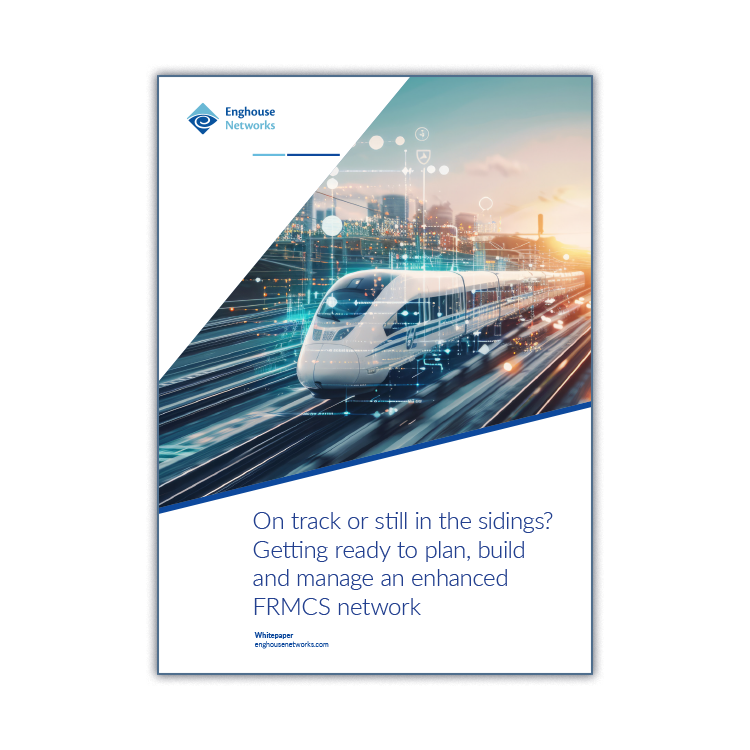
Read our whitepaper On Track or Still in the Sidings? Getting Ready to Plan, Build and Manage an Enhanced FRMCS Network.