

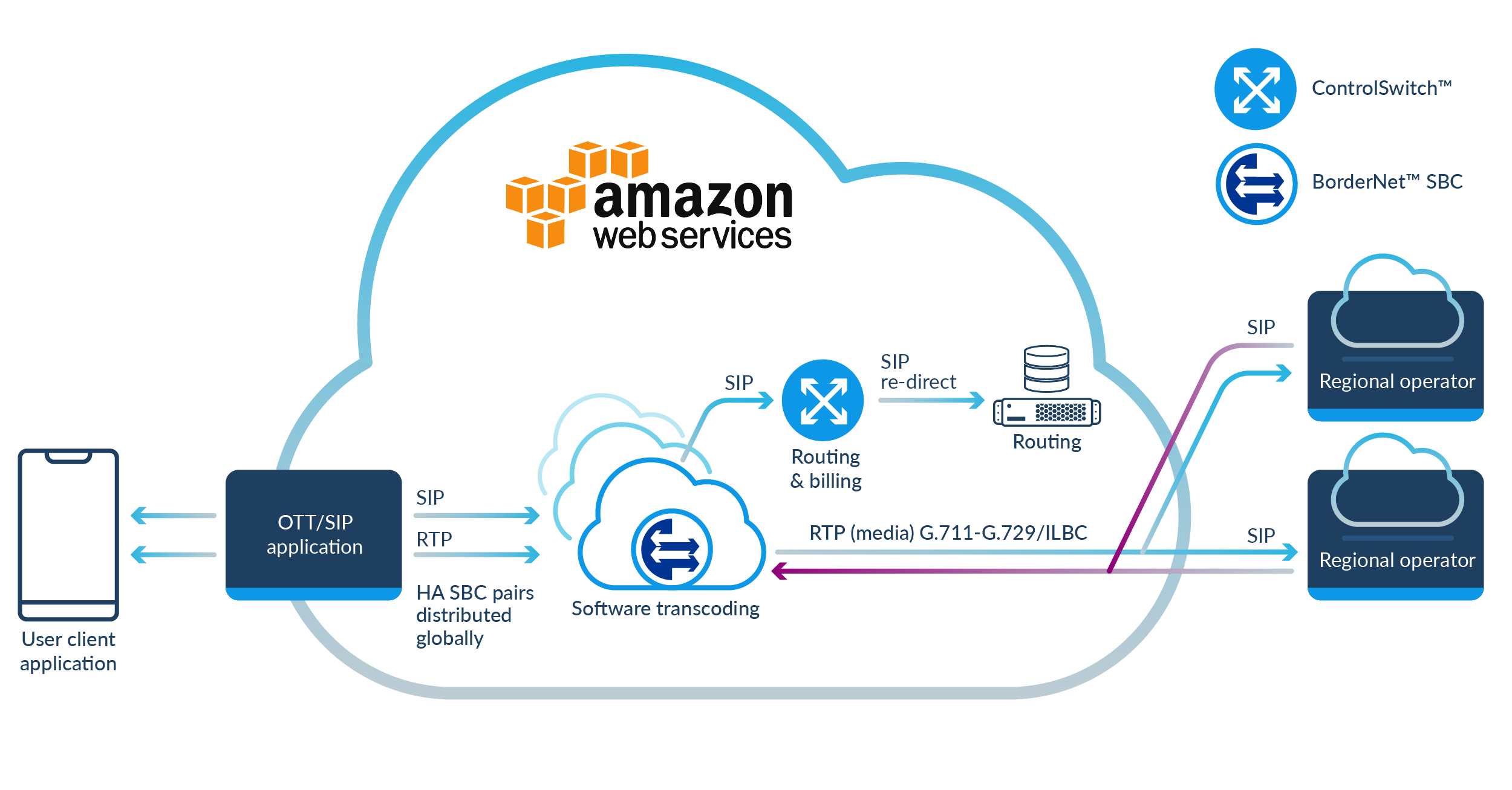
Advances in software-based SBCs mean that communications service providers (CSPs) can deploy SBCs in the cloud without compromising on performance or scale. By deploying SBCs in the cloud, CSPs can enjoy the benefit of deploying services into new regions without requiring a truck roll, which lowers the delivery time and cost of real-time communications. Instead of days and months – deploying new services with cloud-based SBCs can now take hours or even minutes. And because they are easily configurable, SBC performance and scalability can be optimised on demand. Importantly, cloud-based SBCs enable service providers to connect their IP services to PSTN operators around the world effectively by:
- Handling the standardisation and customisation per operator request and regulation per country.
- Being distributed between multiple availability zones to complete software transcoding between Opus to any other codec that is required by the PSTN operators.
- This enables HD voice delivery to the endpoints with cost-effective CPU management and low latency.
Together with the Control Switch, cloud-based SBCs can also support smart routing and complete advanced routing decisions based on the Least Cost Routing (LCR) system. In addition, as the Control Switch engine runs from a core location, it can also handle billing and centralised management and provisioning.

How the Enghouse Dialogic Cloud-Based SBC is Supporting a Unified Communications Provider’s Global Operations
A Unified Communications (UC) provider needed cloud-based SBCs to enable high-quality calls with the scalability they required. It selected Enghouse Dialogic SBCs not only because of the platform’s call routing, policy engines, and software-based transcoding capabilities but also because they are proven in the field. The UC provider is now delivering high-quality, secure IP calls globally thanks to the benefits of deploying Enghouse Dialogic SBCs and Control Switch in the AWS cloud:
- High availability per instance
- Granular distributed instances
- Auto scaling/elasticity
- CPUS dynamic bandwidth adaption
- Dynamic vCPU sharing
- Microservices – transcoding
- Cost-effective network-wide licensing model.
If you are a current Metaswitch SBC user, now is the time to assess your future SBC needs ahead of Microsoft’s expected EOL announcement. Enghouse Networks’ Dialogic SBC offers communications service providers the ultimate in performance, flexibility, and scalability and includes features such as:
- Advanced Capabilities, including:
- Native support for WebRTC, call authentication, fraud detection, SIP recording, Local Number Portability, transcoding, and more.
- Robust traffic monitoring and real-time security features, including topology hiding, built-in firewall, overload protection, dynamic blacklisting, and multiple encryption options such as TLS, SRTP, and WebRTC.
- Elastic search, real-time analytics, and visualisation tools for easy access to live operational data to identify network trends, track real-time service quality, and generate customer reports.
- High-Performance and Scalability: Enghouse Dialogic SBC handles over 100,000 voice sessions at a rate of 1,000 sessions per second – automatically distributing workloads to optimise computing resources.
- Flexible Deployment Options: Enghouse Dialogic SBC can be deployed on-premises with HP OEM Hardware, virtualised with VMWare and KVM, or Cloud-Based via AWS, GCP, and Azure.
- MS Teams Direct Routing and Operator Connect certifications enable Enghouse Dialogic SBC customers to support any SIP-based device or PSTN equipment.
- STIR/SHAKEN support to ensure voice traffic messages are appropriately managed.
- EMS Server Network-Wide Licensing Options: Customers with SBCs deployed across multiple sites or countries can simplify the license tracking of their SBC instances by sharing the licensed pool of SIP and Transcoding sessions.
Learn More
Contact us today to schedule a demo of the Enghouse Dialogic SBC and discuss how Enghouse Networks can future proof your network now.