


Dialogic Session Border Controller
Secures and manages real-time voice and video traffic between networks, ensuring quality, interoperability, and compliance.
Why Choose BorderNet SBC
Flexible SBC Deployment For Telco Cloud, Virtual And On Premise Environments
Enghouse Session Border Controller solutions support cloud, virtual and on premise deployment models, so telecom operators can align with existing infrastructure plans and new 5G and IMS services. Whether services run in a private data center, on public cloud infrastructure or in hybrid models, the platform is ready to deliver:
- Seamless integration with existing OSS/BSS systems
- High availability and scalability to meet carrier grade performance targets
- Low latency processing for real time voice and messaging services
- Geo redundancy and disaster recovery designed for mission critical networks
- Compliance with telecom and regulatory standards
This flexibility lets operators launch services faster, lower infrastructure cost and keep control of sensitive data while staying ready for future network evolution.

Simplified SBC Operations For Telecom Networks
Centralize service management with a GUI and REST API that simplifies SBC operations and connects cleanly with your OSS/BSS stack. The platform is built to reduce operational effort while keeping full visibility and control across services and network elements.
- Single management interface. A user friendly GUI supports rapid provisioning, configuration and monitoring across services and network components
- REST API access. Secure, standards based APIs support automation, orchestration and service assurance flows
- Zero touch provisioning support. Fits high volume, multi tenant environments that need repeatable, script driven activation
- Faster time to market. New offers can be launched and scaled without adding manual overhead
Whether you manage traditional voice or modern IP based deployments, the platform helps telecom operators cut complexity and respond faster to service and traffic changes.
Carrier Grade SBC Performance At Telco Scale
The Enghouse SBC platform is designed for telecom workloads that need high scale, predictable behavior and tight service level targets. Performance is engineered to handle heavy session loads and rapid signaling bursts without service impact.
- High session density. Supports more than 100,000 concurrent sessions per instance for peak traffic periods
- Real time call handling. Manages up to 1,000 calls per second per instance with low latency and high availability
- Horizontal scalability. Scales across many instances or data centers as subscriber and traffic volumes grow
- Resilient architecture. Built in failover, load balancing and geo redundancy help keep services online during faults
The session border controller is designed with security as a core requirement, with protections tailored for telecom networks and SIP based services. Security features address fraud, privacy, compliance and access control in a single platform.

SIP And SBC Security For Telecom Services
The session border controller is designed with security as a core requirement, with protections tailored for telecom networks and SIP based services. Security features address fraud, privacy, compliance and access control in a single platform.
- End to end encryption. Protects SIP signaling and media with TLS and SRTP to shield voice and messaging from interception or tampering
- Fraud protection. Real time analytics for call pattern analysis and thresholds that block toll fraud, robocalls and unauthorized access
- STIR/SHAKEN compliance. Caller ID attestation helps reduce spoofing risk and supports regulatory requirements in North America and other regions
- Secure API access. Role based access control, OAuth2 support and full audit logging for API activity
- Hardened deployment options. Supports secure on premise and cloud deployments aligned with GDPR and other frameworks
This layered approach helps telecom operators meet regulatory demands, protect subscriber trust and keep VoIP, UCaaS and IMS services stable and secure across the network.
Field Proven SBC Reliability In Global Telco Networks
Telecom operators across many regions rely on Enghouse SBC solutions to run critical services at scale every day. The platform has been tested in large, complex environments where service continuity and consistency are essential.
- Carrier grade uptime. Designed for 99.999 percent availability to support mission critical communication services
- Global reach. Active in multi regional deployments across North America, Europe, Asia Pacific, Latin America, Africa and the Middle East
- High performance at scale. Proven to support millions of calls and sessions each day with stable behavior and fast response
- Resilient architecture. Active standby failover, geo redundancy and strong disaster recovery options support business continuity plans
- Validated in production. Deployed in complex infrastructures, including IMS and VoLTE cores, SBC clusters, carrier messaging platforms and modern contact centers
With live deployments across varied telco environments, the platform lets service providers operate with confidence at global scale and deliver consistent experiences to subscribers in each market.

Broad SBC Compatibility Across Legacy And Modern Networks
Enghouse SBC solutions keep services connected across many network types, platforms and protocols so operators can modernize networks without breaking existing services. Both legacy and modern environments are supported during migration.
- Modern network integration. Native support for IMS, VoLTE and VoNR deployments that align with 4G and 5G core architectures
- UC platform compatibility. Works with platforms such as Microsoft Teams, WebRTC and hosted UC systems for enterprise collaboration
- SIP trunking support. Connects to SIP trunk providers and SBCs to deliver scalable voice and multimedia services
- Legacy system bridging. Maintains ties with TDM systems, legacy PBXs and older telephony platforms to support staged migration
- Vendor agnostic deployment. Fits multi vendor environments, with broad compatibility across softswitches, gateways and media servers
This breadth of compatibility helps telcos modernize at a pace that matches budgets and roadmaps while keeping service continuity for existing customers and extracting more value from prior investments.
Click to enlarge image
Session Border Controller for Voice Networks
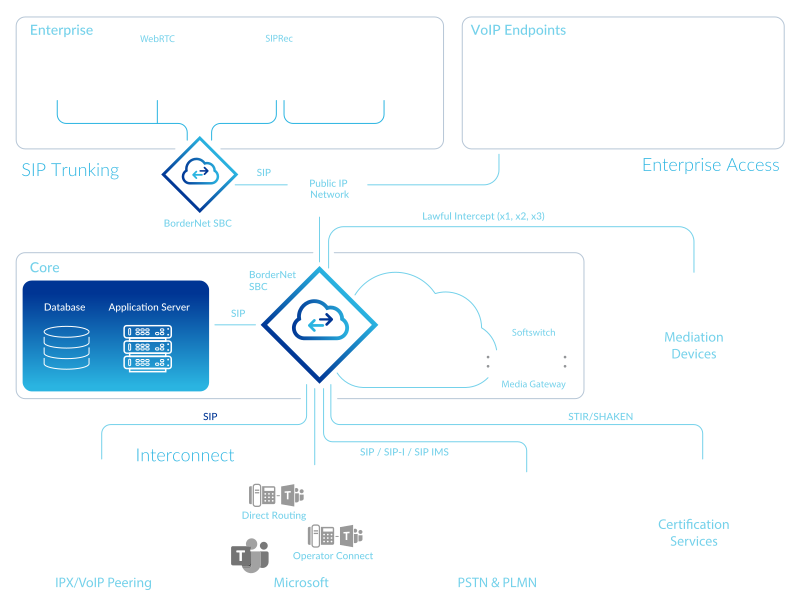
BorderNet SBC is a software-based Session Border Controller (SBC) designed to manage and secure SIP voice traffic across modern and legacy networks.
It supports telecom operators, service providers, and enterprises by enabling interworking between IMS, VoLTE, VoNR, Microsoft Teams, WebRTC, and traditional SIP infrastructures. Whether deployed in the cloud, on-premise, or in virtualised environments, BorderNet adapts easily to your infrastructure and scaling needs.
With strong encryption, SIP header control, and built-in support for regulatory frameworks like STIR/SHAKEN and lawful intercept, it ensures secure and compliant communications.
BorderNet also simplifies operations with centralised GUI, full REST API support, and flexible licensing models, so you can focus on delivering voice services, not managing complexity.
Key SBC Capabilities for Modern Voice Networks


Click to enlarge image
Advanced Media Handling and Transcoding
BorderNet SBC delivers software-based media handling and transcoding to support voice and video traffic across diverse networks and endpoints.
It supports CODEC interworking, HD voice, and adaptive media path control in cloud, virtualised, and on-premise environments. This enables consistent media quality across IMS, VoLTE, WebRTC, and enterprise UC platforms.
Centralised provisioning and network-wide licensing simplify media policy management and help reduce operational costs at scale.
Real-Time SBC Analytics and Regulatory Compliance
BorderNet SBC provides real-time insight into SIP signalling and media performance using an integrated Elastic Stack environment. Operators can detect anomalies, monitor session activity, and maintain voice quality across networks.
To support regulatory compliance, it includes built-in capabilities for identity authentication, lawful monitoring, and accessibility.


Click to enlarge image
SBC Deployment Models and Scalability Explained
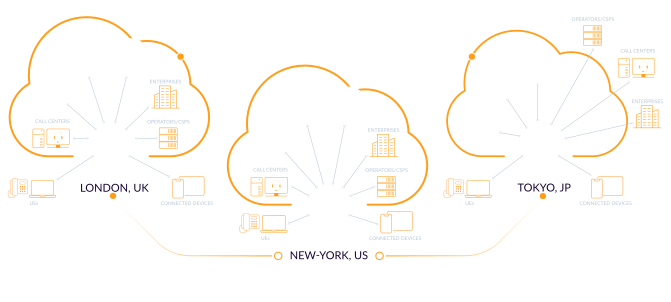
BorderNet SBC is infrastructure-agnostic, supporting deployment across cloud-native, virtualised, and physical environments. It delivers consistent features and performance, whether deployed centrally or at the edge.
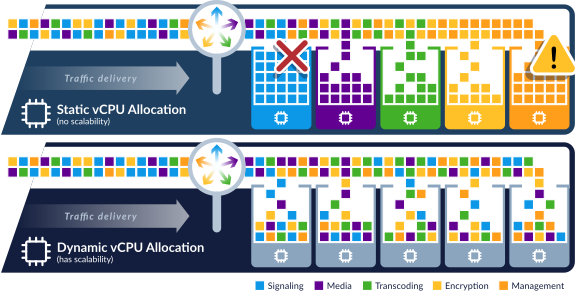
Each instance supports over 100,000 concurrent sessions and 1,000 sessions per second, providing carrier-grade scale for growing networks. Its lightweight software architecture optimises compute usage, with dynamic load distribution across vCPUs and minimal idle capacity.
You can deploy and manage SBCs across your network with:
- Centralised GUI for simplified configuration and monitoring
- Full REST API for automation and OSS/BSS integration
- Network-wide licensing to reduce cost and support flexible expansion
SBC Compatibility with IMS, VoLTE and Teams
IMS / VoLTE / VoNR
Supports full IMS architecture and integration with VoLTE and VoNR deployments in next-generation mobile networks.
Microsoft Teams Certified
Officially certified for Direct Routing and Operator Connect. Connect Teams users to public telephony with ease. Read the certification overview.
IPv4 ↔ IPv6 Transition
Supports dual-stack environments to simplify migration and interoperability between IP versions.
Legacy Protocols (SIP / H.323 / NGN)
Maintains compatibility with older voice systems, including H.323 and NGN SIP, for smooth coexistence.
Hosted UC / PBX / CCaaS / UCaaS
Works with unified communications platforms and cloud-based contact centre services.
WebRTC & SIPREC
Bridges WebRTC endpoints with SIP infrastructure and enables SIP-based call recording for compliance and analytics.
Voice networks are changing fast. We help operators stay ahead with a cloud-native SBC that secures traffic, simplifies operations and adapts to your infrastructure.
From SIP trunking to IMS, from Microsoft Teams to WebRTC, BorderNet SBC makes it easier to connect, protect and grow without the burden of legacy systems.
It’s time to simplify, scale and move forward with confidence.
FAQs
Session Border Controller
Yes, SBC solutions support direct routing for Microsoft Teams. They enable secure and seamless connectivity between Teams and external networks, providing features like SIP call routing and enterprise-grade security.
SBCs integrate STIR/SHAKEN frameworks to authenticate caller identities and prevent robocalls. This ensures compliance with regulatory standards and improves overall trust in telecom communications.
Yes. A single BorderNet SBC instance can handle more than 100,000 concurrent sessions and around 1,000 sessions per second, which fits carrier interconnect and IMS roles as well as high density enterprise SIP trunking. Several instances can be combined with central element management and FCAPS control for larger fabrics across data centres and cloud regions. This makes the same SBC suitable for small edge roles and large core deployments.
SBC solutions can be deployed in various environments, including on-premises, cloud SBC architectures, and hybrid models. They support platforms like Windows SBC, open-source SBCs, and enterprise session border controllers for scalable and flexible deployments.
SBCs enhance VoIP security by encrypting SIP signaling, detecting and mitigating spam, and providing robust traffic management. Features like rogue RTP detection and traffic shaping ensure secure and optimized VoIP communication.
SBCs use advanced protocols like STIR/SHAKEN and secure SIP signaling to authenticate callers and prevent identity spoofing. This improves trust and compliance in telecom communications.
SBCs enable gateway distribution tracking by monitoring and managing signaling and media flows across network gateways. This ensures optimal resource utilization and efficient traffic routing.
SBCs streamline communication border design by managing signaling, media, and policy enforcement between networks. They ensure reliable and efficient interconnectivity with features like adaptive traffic prioritization and SIP normalization.
Enterprise SBC solutions include advanced routing, real-time analytics, caller authentication, fraud prevention, and seamless integration with enterprise communication platforms like Microsoft Operator Connect and direct routing SBCs.
SBC solutions enable WebRTC control by managing secure signaling and media streams for real-time communications. They provide WebRTC check tools and support for STIR/SHAKEN protocols to ensure secure and reliable WebRTC-based communications.
The Dialogic SBC applies several layers of SIP and media security. It hides internal addresses, inspects SIP messages, filters malformed or hostile traffic, and enforces access rules. Encryption options include TLS and IPsec for signalling and SRTP for media, so voice and video sessions are protected in transit. Features such as message flood protection, dynamic access lists, bandwidth control and overload handling help guard against DDoS, toll fraud and service abuse on carrier and enterprise borders.
The Enghouse BorderNet SBC is certified for Microsoft Teams Direct Routing and supports Operator Connect integrations. It connects Teams tenants to public telephony and SIP trunks while handling SIP to Teams signalling, media negotiation and security. This lets service providers and operators offer Teams based voice services with carrier grade protection, routing and analytics while keeping control over numbering, policies and interconnects.
BorderNet SBC provides detailed insight into SIP signalling and media performance, with real time statistics and integration with Elastic based analytics for deeper views of sessions and trends. For compliance, it supports STIR/SHAKEN caller identity, lawful intercept interfaces, SIPREC recording and features for accessibility such as RTT and TTY. These functions help operators meet regulatory duties, support audits and feed quality and capacity analysis across voice networks.
SBCs mitigate SS7 vulnerabilities by using secure signaling, encryption protocols, and advanced firewall features. They also support fraud detection, spam prevention, and secure routing to protect telecom networks from attacks.
BorderNet SBC includes STIR/SHAKEN capabilities so operators can sign and verify caller identity on SIP trunks. This helps reduce spoofed caller IDs and supports regulatory frameworks in markets that require attestation for voice traffic. Combined with call routing policies and fraud controls, these features allow providers to block or treat suspect calls differently and give enterprises cleaner traffic on inbound SIP connections.
BorderNet SBC is designed for mixed network environments. It supports IMS architectures, VoLTE and VoNR deployments, and can act at access or interconnect borders in mobile and fixed networks. At the same time it maintains compatibility with legacy SIP, H.323 and NGN platforms, and supports IPv4 and IPv6 together, so operators can move toward 4G and 5G cores while keeping ties to older systems and services.
Dialogic BorderNet SBC provides software based media handling and transcoding so calls can flow across different codecs, networks and devices. It supports codec interworking, HD voice and media path control for SIP and WebRTC traffic across cloud, virtual and on premise deployments. Native software transcoding uses multi core resources efficiently, so operators and enterprises avoid separate hardware for media conversion and can adapt policies as traffic patterns change.
A firewall focuses on general IP traffic and ports, not on SIP sessions or media flows. A PBX manages internal call features and routing for users. A Session Border Controller sits at network borders, understands SIP signalling and media, and applies call level policy, security, routing and media handling between networks. Dialogic BorderNet SBC can sit in front of PBXs and UC platforms, and alongside firewalls, to provide SIP aware control and protection for VoIP, video and collaboration services.
SBC communications optimize VoIP by providing secure SIP signaling, robust traffic management, and quality assurance. They also enable media transcoding and secure interconnectivity between VoIP and legacy networks.
Cloud SBC solutions offer scalability, flexibility, and cost efficiency. They support seamless integration with telecom and enterprise networks, ensuring secure signaling and media processing in virtualized environments.
