
Intelligent Routing Platform
Intelligent call routing and service control for telecom networks

Apply dynamic routing logic across voice services and destinations
Enghouse Networks Intelligent Routing Platform enables operators to transform traditional voice networks into flexible, service-driven environments. With intelligent routing, number translation, and rule-based call distribution, operators can optimize traffic handling and deliver tailored services to enterprise customers.
Key Benefits
The platform integrates seamlessly with existing telecom network environments and supports flexible deployment models, allowing operators to modernize routing capabilities without disrupting current operations.





Capabilities / Key Features
The Intelligent Routing Platform provides a centralized environment for defining routing logic, managing numbering plans, and distributing calls across destinations based on configurable rules.

Through a web-based interface, operators and authorized enterprise customers can configure routing scenarios, enabling greater flexibility and faster service adjustments without complex network reconfigurations.
Scenario: Telecom operators must manage increasing volumes of voice traffic while supporting complex routing requirements from enterprise customers. Traditional network configurations often lack the flexibility to adapt routing policies quickly or introduce new routing scenarios, limiting operational agility, and increasing manual effort.
Solution with Intelligent Routing Platform: By enabling real-time number resolution and rule-based routing control, Enghouse Intelligent Routing Platform allows operators to dynamically manage traffic flows across voice services. Routing policies can be configured and adjusted centrally, supporting flexible call distribution and rapid adaptation to changing service requirements.
Results: Improved routing flexibility reduced operational complexity, faster implementation of routing changes, and more efficient traffic management across voice networks.
Why Choose IRP?




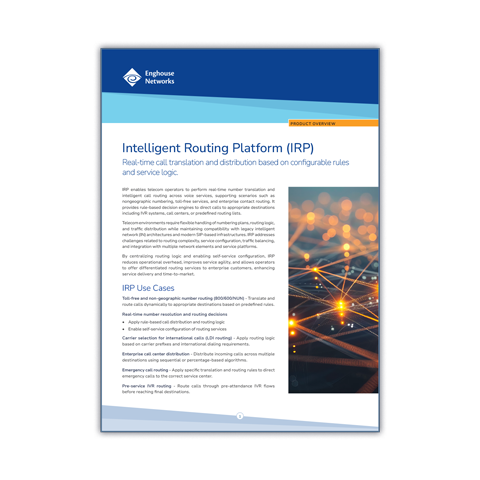
Control and optimize voice traffic across increasingly complex routing environments.
Telecom operators must manage growing volumes of voice traffic while supporting diverse routing requirements driven by enterprise services and interconnection agreements. Static configurations limit flexibility and slow response to changing traffic patterns.
Enghouse Networks helps operators dynamically control routing decisions through configurable policies, enabling efficient traffic distribution and improved resource utilization. This allows operators to adapt quickly to business needs while maintaining service performance.
FAQs
IRP
Yes. IRP includes a self-service management portal (FEM — Front End Manager) that allows enterprise administrators to configure routing rules, schedules, destination lists, blacklists, and IVR flows without operator intervention. The portal supports role-based access and can be customized per customer segment.
IRP supports sequential, percentage-based, priority-based, and forking distribution algorithms. Operators can define overflow rules, retry logic, and release cause-based handling to ensure calls reach the correct destination even under high traffic or destination unavailability.
Modernizing an IN platform should not require a disruptive infrastructure project. IRP deploys on existing virtualized environments eliminating dedicated hardware costs and aligning intelligent network services with the operator’s broader telco cloud strategy.
IRP enables operators to structure differentiated routing service packages by customer segment — SMB, Enterprise, and Government — with distinct capabilities and flexible pricing models, including pay-per-use and tiered plans. This allows operators to monetize existing IN infrastructure with new commercial offers without custom development.
IRP integrates natively with IVR platforms for pre-service routing flows, supports hosted waiting queues, and connects with carrier networks for LDI routing. It is compatible with both legacy IN infrastructure and modern SIP-based environments, enabling end-to-end call handling across heterogeneous network architectures.
IRP applies a configurable rule engine that evaluates call parameters — origin, destination, time, traffic volume, geographic location, and number portability status — to determine routing destinations dynamically. Rules can be updated through the self-service portal without service interruption.
In legacy IN platforms, every routing change requested by a corporate customer generates a work order for the operator’s support team. IRP’s self-service portal transfers that configuration capability directly to the enterprise administrator — reducing MAC (Move-Add-Change) costs and freeing operations teams from routine provisioning tasks.
IRP includes a built-in SIP signaling diagnostic tool (Tracer) that enables operators to analyze call flows, identify routing issues, and validate configuration changes before full deployment. This reduces mean time to resolution and minimizes the risk of service-affecting changes.
Legacy IN platforms handle routing through fixed configurations that require operator intervention for every change. IRP centralizes routing logic in a configurable rule engine, supports both legacy IN and modern SIP environments, and adds a self-service portal that allows enterprise administrators to manage their own routing rules — without generating support tickets on the operator side.
IRP is an Intelligent Routing Platform that enables fixed network operators to modernize their IN services — from real-time number translation and rule-based call routing to enterprise self-service configuration. It addresses a common gap in legacy IN platforms: the inability to offer B2B customers self-service capabilities, the difficulty of migrating to virtualized infrastructure, and the operational cost of managing routing changes manually.
IRP supports toll-free and non-geographic number routing (800/600/NUN), enterprise call center distribution, pre-service IVR routing, emergency call routing, and international carrier selection (LDI). It also enables operators to structure differentiated service packages by customer segment — SMB, Enterprise, and Government — with distinct routing capabilities and pricing models.
IRP delivers real-time traffic monitoring, operational KPIs, and business reports covering call volumes, distribution patterns, call completion rates, and top services by traffic. Reports are available both to the operator and to enterprise administrators through the self-service portal — and can be offered as a billable add-on feature.