

While it may have had a different name, bridging today’s digital divide has been nearly a 90-year national ambition, since the U.S. Communications Act of 1934. This Act, which stated that all people shall have access to rapid, efficient, nationwide communications service with adequate facilities at reasonable charges, acknowledged the importance of access to communications to support rural health care, education, and the economy.
Fast-forward to 2019, the US Chamber of Commerce published a study that suggested the lack of access to online tools and digital services will cost rural areas 360,000 full-time jobs and $140 billion in contributions to the U.S. economy between 2019 and 2022. For rural economies, the greater adoption of digital technology had the potential to grow revenues of rural businesses by $84.5 billion each year (21%). This study was conducted before the COVID-19 pandemic – which put the real consequences of the digital divide into each school, business, and home almost overnight. According to a recent report into broadband access and its impact on rural employment during COVID-19, found that:
- In May 2020, 35.2% of the U.S. workforce was working remotely full time, compared to 8.2% in February of 2020.
- 16.1% of retail sales were conducted online in the second quarter of 2020, up from the pre-pandemic rate of 11.3% – equating to a 40% spike in e-commerce, the largest in U.S. history.
Clearly, rural communities without broadband access were at a distinct disadvantage in regard to work, commerce, and education during the COVID-19 lockdown.

In an effort to close the gap in the U.S. digital divide and generate economic activity across the country, billions in funding have been allocated by the federal government, such as the Rural Digital Opportunity Fund and the Universal Service Fund. These funds are actively pursuing the mission of equitable access to broadband. It’s expected that it will take nearly 300 carriers to provide new deployments in 47 states to bring broadband to almost 2.7 million locations. So, how can carriers expedite the rollout of broadband in America’s heartland?
One of the key ways is to ensure that a carrier’s operations support solutions (OSS) are equipped to manage the rapid rollout of 5G and support the digital transformation of the rural economy. But what does a next generation OSS system look like?
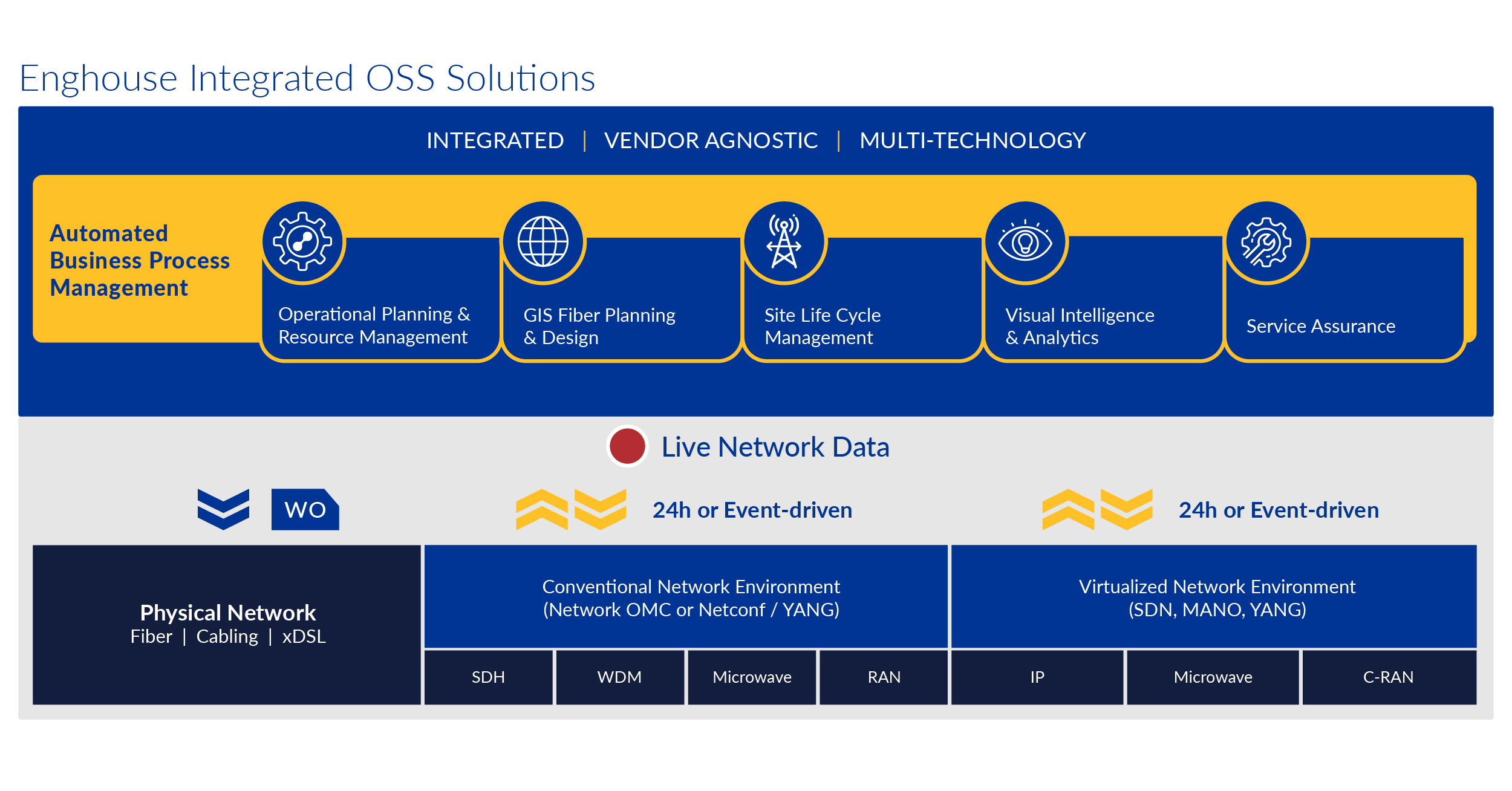
Significant new fibre buildout requires Design and planning to ensure efficient delivery of services to all target consumers and businesses. GIS systems to plan where fibre and outside plant should be located is critical to ensuring engineering teams know what to deploy where to serve the target area. Signal link budget tracing and validation is required to ensure the right capacity is available at the end points. Bill of materials need to be created and costs estimated, orders placed, and installation team given clear instructions. There also needs to be an understanding of poles and ducts, easements, and rights of way for overhead or underground deployment. Redesign may be required to accommodate unforeseen challenges and this needs to be tracked. With integrated geo-spatial tools, planning engineers and network designers can quickly baseline a fibre network design and pre-build Fibre-to-the-Home. Not only is it important to have network topology-based fibre design automation features to conduct network proximity analysis, distance to source, and end-point connectivity, proven next-gen OSS systems can also provide cost estimations to build the business case.
Access to customers may be offered using Coax/DOCSIS, Fibre, fixed wireless or 4/5G technologies. Once the access is available then operators need to plan how they deliver services to these consumers – residential services like Internet, video, voice and IoT; business services adding connectivity, contact centres, data-centres, and other services. All these services need to be planned so they can be delivered in the most efficient manner possible. This involves understanding the services to be delivered, the layer of the network involved in their delivery (e.g. Layer 0-3); how services are delivered at the edge of a network (wired or wireless) and routed through the core. Once the services are defined then the equipment and the equipment configurations necessary to deliver them to the target SLA needs to be planned, BOMs (bill of materials) created, and installation and configuration instructions provided.

Accuracy in the planning phases is essential, as the FCC has signaled increased audits and verification on winning bids to avoid over-building, and to ensure that the network buildouts are delivered as intended. Accurate information equips construction crews and sub-contractors with critical and accurate information in the field, such as redlining, capture as-is, construction drawings, map books and staking sheets – helping avoid costly truck rolls and delays. Increased network visibility also helps operators to minimise downtime by enabling network teams to isolate and assess the impact of network failures, analyze field measurements or service degradations.
Once the services have been planned and deployed then the network inventory and topology need to be tracked and monitored. Networks are living – there are almost continuous adds, moves, and changes. As these changes are made the impact needs to be understood to ensure that the network continues to support the services being deployed over it. Also, services are not static, and the services carried over the network are also changing as customers get added and moved and services get added and changed. Again, it is critical to track all these changes to ensure that the network continues to meet the service commitments made.
The services running over the network need to be assured – meaning ensuring that SLA commitments can be supported. Tracking services is also key as services are paid for and if a service is not properly removed from a network after it is changed or cancelled then it will continue to consume resources; or conversely, if a customer is receiving a service but is not being billed for it, then there is revenue leakage. It is also critical that the network is monitored, both to understand when service impacting issues have occurred, and to be proactive in determining when resources are reaching limits which may lead to future issues. And all this needs to be done over networks which are usually multi-vendor, multi-technology and multi-generational.

Finally, most network operators are focused on making the operation of the network as simple as possible. This is so they can reduce costs, but also because networks and the services running over them can be so complex no personnel can manage them without assistance. This means a focus on automation is key. Automation of root cause analysis/service impact analysis; automation of actions like notifications and ticketing and automation of recovery actions.
Wider availability of high-speed internet access not only improves education and training, better access to digital talent, and innovation incentives, 5G networks also offer access to affordable cloud services that support new service creation and increase cost efficiencies for rural businesses. By investing in an end-to-end integrated OSS system, operators can meet the increase in demand for bandwidth, reliability, low latency, and FTTx services that rural American businesses crave and deserve.
Contact us today to learn how you can ensure your OSS will help close the digital divide.